
A World of Falling Prices
One upward trend I see is people complaining about constant price increases — and rightly so!
Unfortunately, far too many people point in the wrong direction. Far too many blame various ideologies, people, parties, and so on as the cause. Unfortunately, we just have to dig even deeper than that, so let me give you an overview.
What Is Money?
To understand the problem with money, we first have to understand: what is money? Money is, boiled all the way down, a store of your time and energy (productivity) for later use.
In other words, you spend an amount of your limited time on this earth (work), and you convert that time and energy into money (wages). Since your time on this planet is 100% limited, the perfect store would likewise be 100% limited — but it isn’t.
The Fixed Exchange Rate Policy and the Euro
Denmark has had a fixed exchange rate policy against the euro since 1999. In short, this means that the National Bank’s purpose is to constantly hold the value of around 7.45 kr to €1 — so let’s look at the euro.
Since 1999, the number of euros in existence has grown by +5.5% per year. That adds up to over 300% in total!
What does this mean?
Well — the more money that exists, the more its value/purchasing power falls. In other words, you can’t get the same for your 100 kr today as you could in 1999.
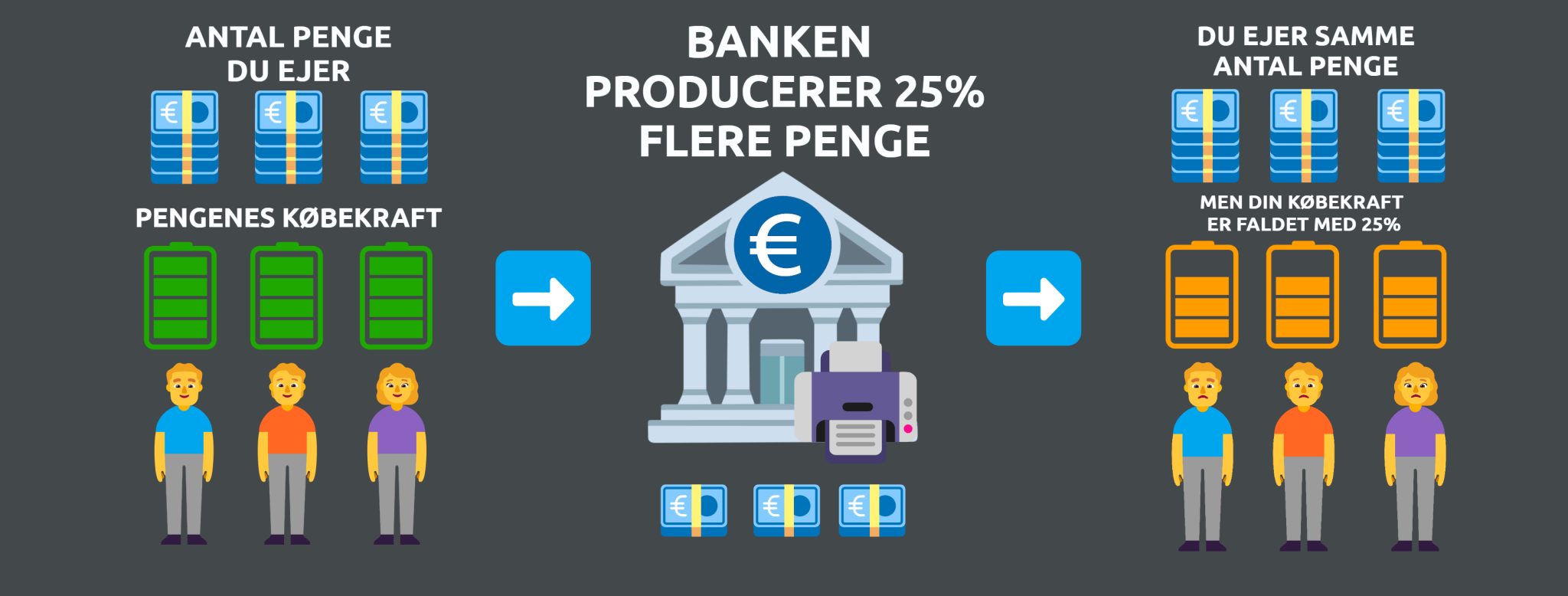 An illustration that even if you’re left with the same number of units of money, the value of money falls the more money is produced; you can’t buy the same things = also called inflation.
Property Prices Follow Money Production
If, for fun, we look at owner-occupied flats (across the whole country) and the price difference between today and 1999, we can see that prices for an owner-occupied flat have risen by an average of 5.5% per year — in other words, prices simply follow money production ~1:1, and that’s why property is used as a form of “savings” today.
Average price per m² for an owner-occupied flat:
- 1999: 9,261 kr.
- 2023: 33,353 kr.
This means your purchasing power is halved every 8 years!
Why the CPI Doesn’t Show the Real Inflation
“But, but, but — inflation isn’t 5.5% per year!”
Exactly. And the reason for this is that “inflation” is measured through the CPI (consumer price index), which doesn’t capture the real world.
How Money Is Produced Through Debt
Money is produced through debt. Let’s say you want to buy a house for 1,000,000 kr — roughly, it would look like this:
- You put down 100,000 kr
- The bank produces 900,000 kr, which you promise to pay back over 30 years (+ interest)
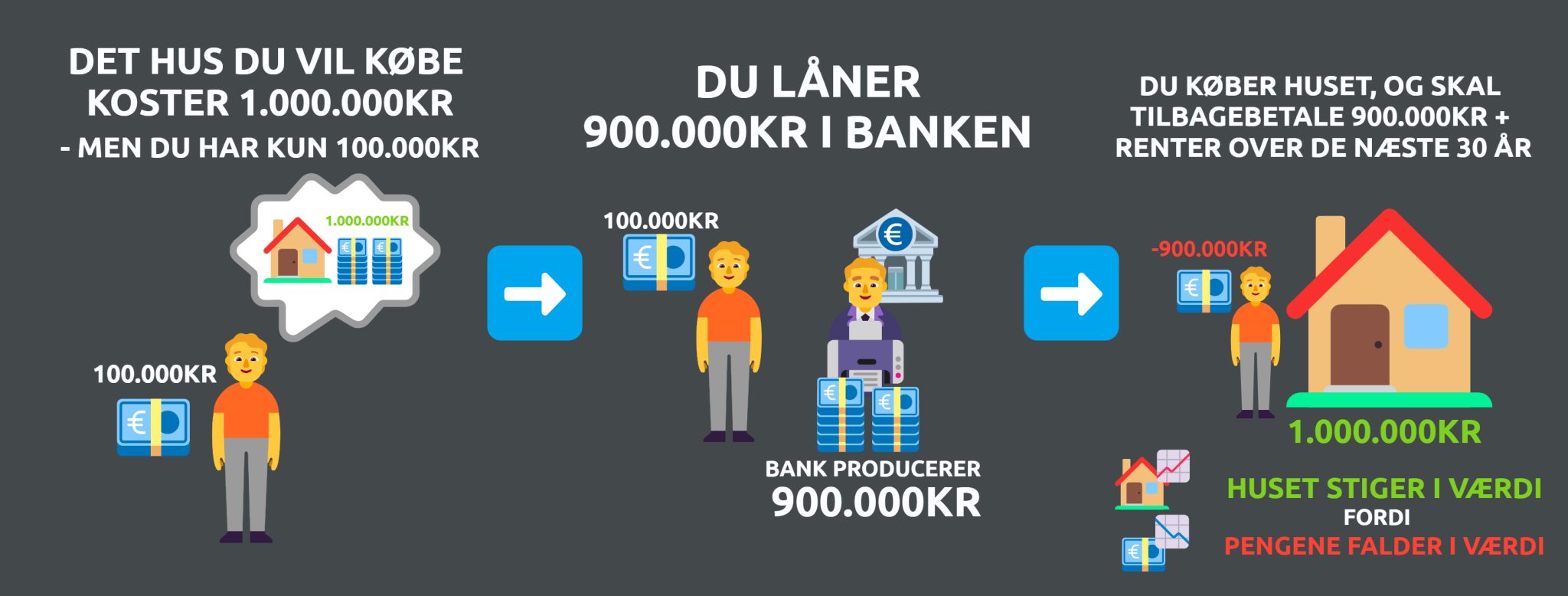
We know that money loses purchasing power year after year, so 1,000,000 will be worth far from the same today as over the next 30 years — so both the banks and the borrowers are happy.
The Cantillon Effect
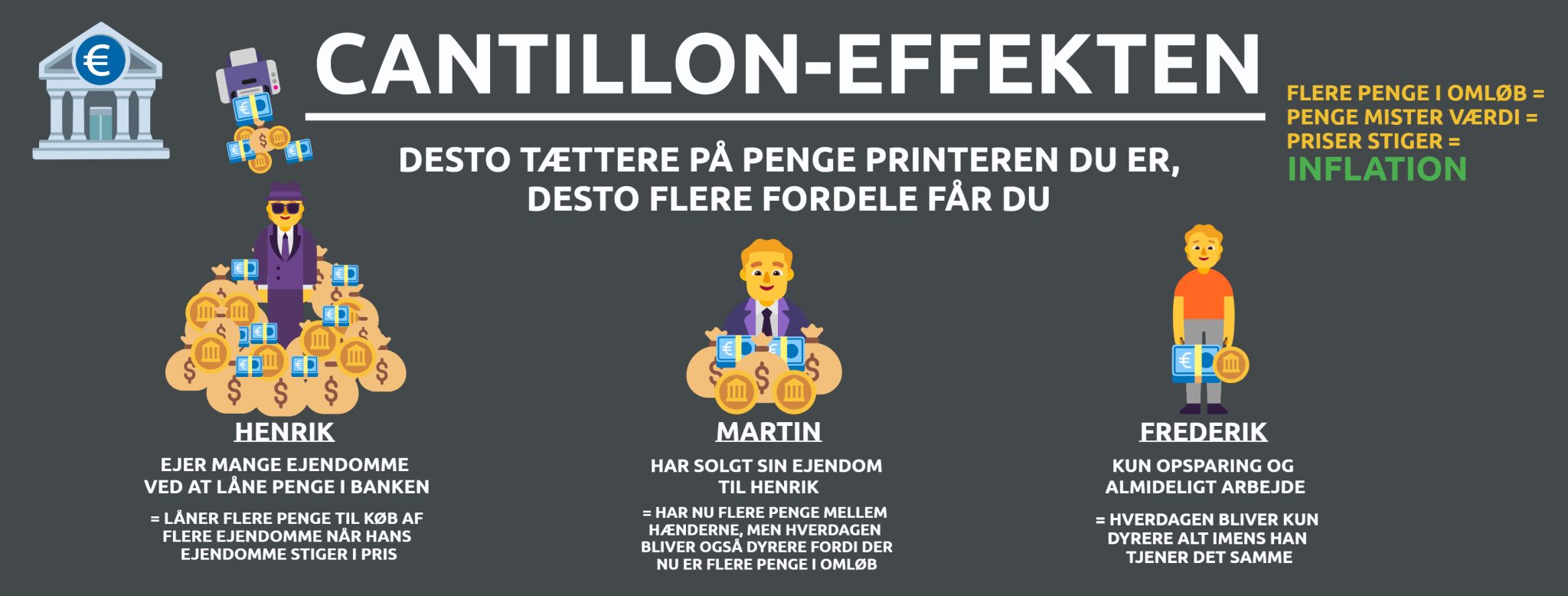
If you wait a few years, the value of your house rises, which makes it possible to buy another one by borrowing more money from the bank — and it’s precisely this loop that tons of investors exploit to their own advantage, creating what’s called the “Cantillon Effect” = the rich own investments like property, which grow in value along with the money supply, while everyday life for the poor simply gets more expensive.
Investors know full well that 5.5% more property isn’t produced each year, so they store their wealth in property.
Technology Is Deflationary
“But why doesn’t our everyday life, measured by the CPI, get 5.5% more expensive each year?”
Because technology is deflationary and growing exponentially. We don’t “unlearn” new technologies, so the real production value constantly becomes worth less — that is, fewer working hours are needed to create the same product. We’ve gone from having to pay money per photo we take, to being able to take infinite photos on a handheld supercomputer.
That’s why inflation is measured through the CPI.
Wages Don’t Rise Enough
“But our wages rise too!”
Yes, just not by as much as your purchasing power falls in value each year. On average, our wages rise by around ~1.5% per year. The reason for this is that this entire debt-based system would fall apart if people’s wages grew with the real inflation of 5.5%.
Back to the start: money is the store of your time, energy, and productivity for later use. The best money is therefore the one closest to 1:1 with your time and energy — that is, as limited in quantity as possible.
If your money falls by 5.5% in value each year, and your wages only rise by 1.5%, then you have to work even longer or harder just to maintain your purchasing power = theft of time.
Deflationary technology should make our everyday life cheaper, but because we price our everyday life in money whose supply grows by 5.5% per year, our everyday life rises in price.
What Is the Solution?
It shouldn’t be this way. Our limited time is our most valuable asset, so we humans should be able to store it in something equally limited — but that has never been possible. Throughout human history, we’ve seen that the person/authority with the ability to increase the amount of money in circulation will ALWAYS increase the amount of money in circulation.
Requirements for the Perfect Money
First and foremost, we need to find a type of money with a 100% known maximum supply. This money must be completely out of the control of individuals to change the monetary policy.
This money must not be producible out of thin air at the push of a button; that is, energy and capital must be used in its production — a bit like gold. About 1.5% more gold is mined each year.
Gold’s Limitations
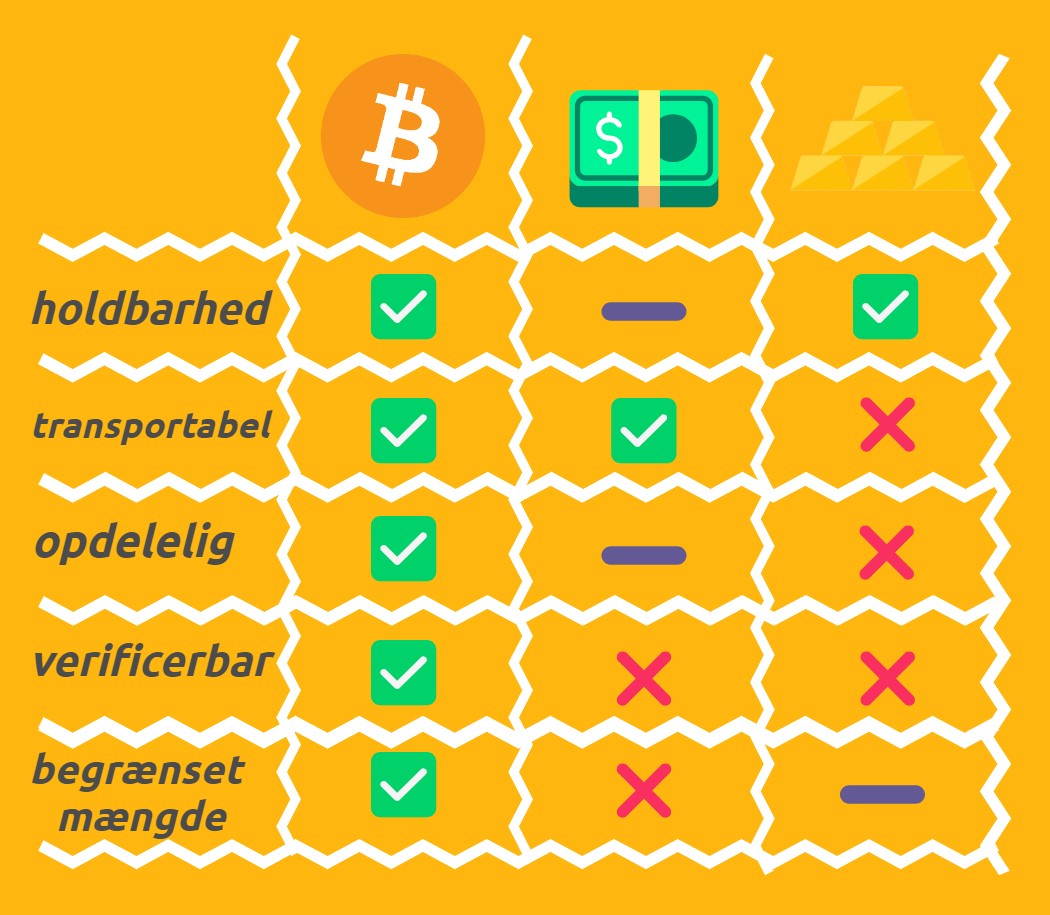
Gold’s value comes from how difficult it is to produce/mine it. However, gold has some “flaws” that make it difficult to use in everyday life, because:
- You can’t pay with gold over the internet
- Your gold can be confiscated
- It’s incredibly hard and time-consuming to divide gold into smaller parts
- It’s hard and time-consuming to verify its authenticity
- It’s hard to transport your gold across borders
- If gold’s purchasing power rises a lot, the supply grows at the same time, since more people will try to mine it. There are huge amounts of gold in the oceans (and in space), which over time will also be extracted; an elastic supply.
But — in return, it’s a closer 1:1 with your limited time, and therefore a better store of value than your money.
The Perfect Money
So — which type of money would then be the best? As mentioned, it must not be producible out of thin air at the push of a button or controllable by individuals, and it must be limited.
In addition, it must be able to:
- Be easily divided into smaller pieces
- Be sent over the internet
- Be 100% limited, so it reflects your time as closely as possible: 1:1
- Be verifiable instantly
- Be easily transported around the world
- Last forever
Only one money possesses all these properties, and that’s Bitcoin.
How Bitcoin Works
Protocol and Rules
Bitcoin is a protocol, a bit like the TCP/IP that the internet we know today is built on.
This protocol contains some rules that can only be changed if everyone agrees. These rules include the rules about monetary policy.
1 BTC can be divided into 100,000,000 SAT, a bit like 1 krone can be divided into 100 øre.
Mining and Monetary Policy
Here comes the technical side of the monetary policy:
When a transaction is made, it has to be verified by a network of computers. These computers are called miners. Miners use computing power, and therefore energy, to mine Bitcoin. The miners know nothing about who is sending or receiving a transaction, so there’s no discrimination between different transactions — their purpose is simply to accept that the money should go from A to B.
Every ~10 minutes, all the transactions are stored in a “main ledger” called a blockchain (transactions are only completed once they’re placed in a block on the blockchain), after a lucky miner has correctly guessed a number; a kind of lottery, you could say.
Halvings and Limited Supply
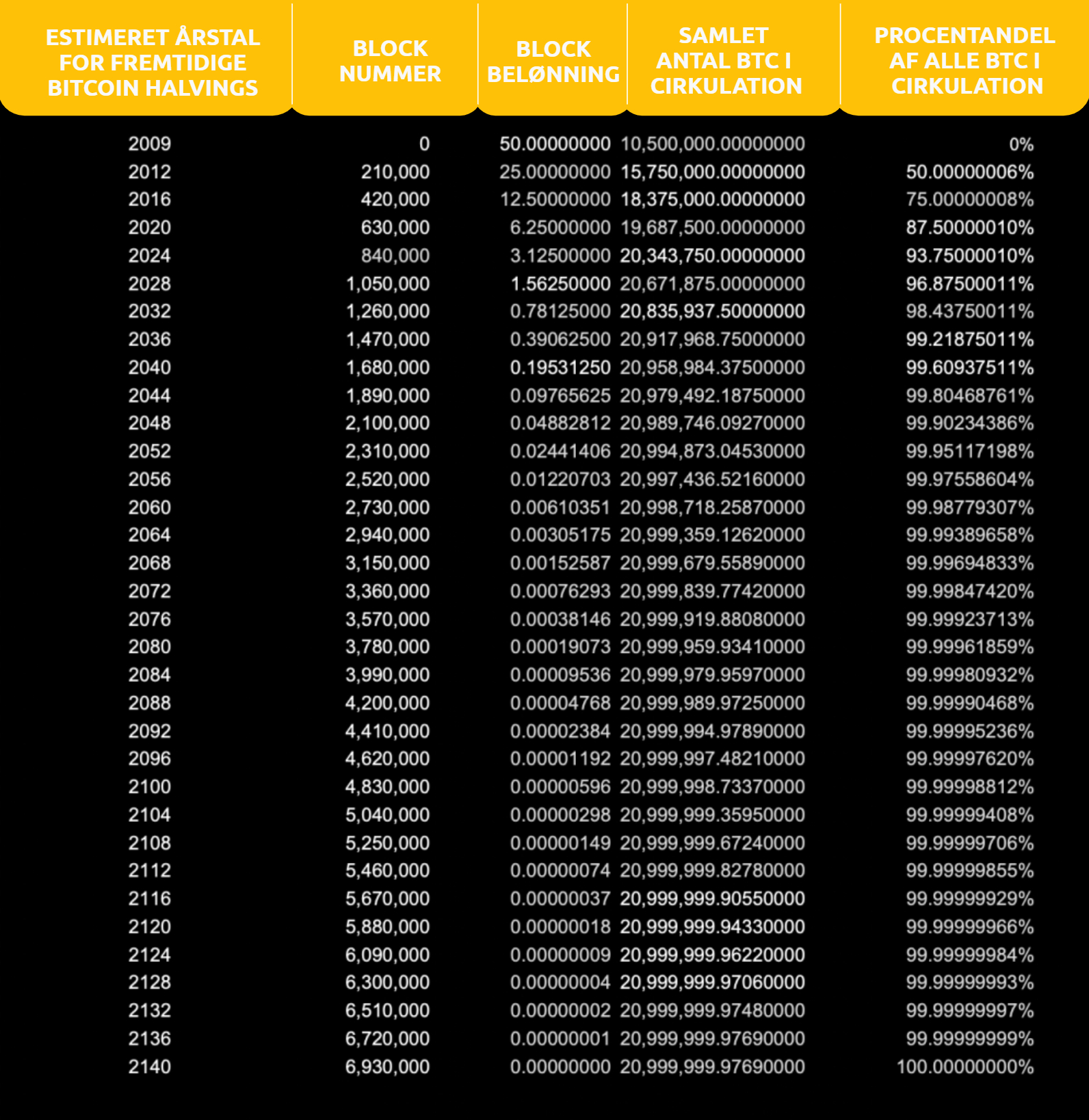
The reward for guessing this number correctly started, right at the beginning, at 50 Bitcoin (BTC).
The code is built so that every 210,000th block, the miners’ reward is halved. So if we calculate 210,000 × 10 minutes, we get about 4 years.
So the future reward goes from:
- 50 BTC → 25 BTC → 12.5 BTC → 6.25 BTC, and so on
The Difficulty Adjustment
But how is it ensured that it takes about 10 minutes for a miner to guess correctly? It’s done through a difficulty adjustment.
As mentioned, one of the problems with gold is that the more its value rises, the more the supply rises — Bitcoin doesn’t have this problem, thanks to this difficulty adjustment.
Bitcoin’s code includes an adjustment to how hard the number that miners have to guess is to guess. The difficulty is constantly adjusted every 2,016th block.
So let’s say the value rises a lot, and more people start mining Bitcoin — then this number will be guessed faster than 10 minutes. But the difficulty will then rise after the 2,016th block — and so it will again take about 10 minutes to mine a block.
In other words — Bitcoin has an inelastic supply. The supply stays the same over time no matter the demand, unlike gold.
The Math Behind 21 Million
Anyway, back to how we know that Bitcoin is 100% limited: it’s simple math.
- 50 BTC × 210,000 = 10,500,000 BTC
- 25 BTC × 210,000 = 5,250,000 BTC
- … and so on
This continues until the reward is 1 SAT (0.00000001 BTC) × 210,000, after which we get a total of around ~21,000,000 BTC.
Since the code says there are no smaller pieces than 1 SAT, the reward can no longer be halved, so these rewards stop. Miners will therefore no longer receive a block reward; instead, they simply live on the transaction fees that come from carrying out a transaction.
Is Bitcoin Mining Bad for the Environment?
“But Bitcoin mining is bad for the environment, isn’t it?”
Wrong. This is a misconception, because it fails to account for several different things.
The Development of Technology
The development of technology: we’re constantly becoming more energy-efficient. For example, you could easily calculate that if everyone on the planet used an MP3 player in 1980/1990, MP3 players would use X% of all the world’s total energy. But the fact is that technology is constantly developing.
The more energy-efficient we become, the more opportunities will open up that allow us to develop as humans. Think about it:
- Do you take the cannon or the plane when you travel around the world?
- Do you take the train or the bike when you go to the other end of the country?
- Do you send letters or messages when you need to contact someone?
- Do you read the news in the newspaper or on the internet?
- Do you take individual Polaroid photos, or infinite photos on your handheld supercomputer?
- Do you use a physical calculator or the built-in free version on your phone?
In other words, if humans see value in using energy, we’ll embrace it and incorporate it into our everyday lives.
Bitcoin and Renewable Energy
The idea of being able to send value over the internet in a split second is an idea that a large share of people will see enormous value in. Bitcoin gives 100% ownership over your wealth, since it’s the first unconfiscatable property we’ve ever had. You can store your entire wealth in your head simply by remembering 12 words.
At the same time, we have to remember what it is that Bitcoin replaces.
Bitcoin miners look for the cheapest possible energy source. What are these? Wasted and renewable energy.
Around the planet, there are tons of untapped energy sources that aren’t being used because, economically, it’s too big a gamble to start energy companies there; after all, who’s going to buy the energy? That problem is solved by Bitcoin miners. Bitcoin miners can easily be switched on and off depending on the need for their use. For example, wind turbines occasionally produce far too much energy, which can’t be 100% stored. There, instead of the energy going to waste, you could monetize this wasted energy by letting Bitcoin miners buy it.
Another thing is that on oil platforms, among other places, methane gases are constantly being flared off and simply released. These methane gases could easily be “captured” and used to produce more energy, thereby reducing methane emissions — but it just doesn’t make economic sense for these platforms: until now. Oil platforms can use the methane gases to produce energy and then let Bitcoin miners buy this newly produced energy.
In other words — Bitcoin miners create an incentive to further develop the production of renewable energy sources.
The Lightning Network
“But do you really have to wait 10 minutes every time a transaction goes through?”
No. This only applies on Bitcoin’s “settlement layer”.
As mentioned earlier, Bitcoin is a protocol on which things can be built. For example, a layer has been built on top of Bitcoin called the Lightning Network (LN).
LN should be seen as a payment network, a bit like VISA/Mastercard. LN makes it possible to move Bitcoin from A to B in a split second for ~0% in fees. VISA/Mastercard today take 2%–2.5% in fees on EVERY transaction, because there are so many different parties involved.
So LN is a superior network compared to VISA/Mastercard, and so on. But what if you don’t want to use Bitcoin and only the Danish krone? — No problem. LN can be incorporated in such a way that only the network is used, so it would look like this:
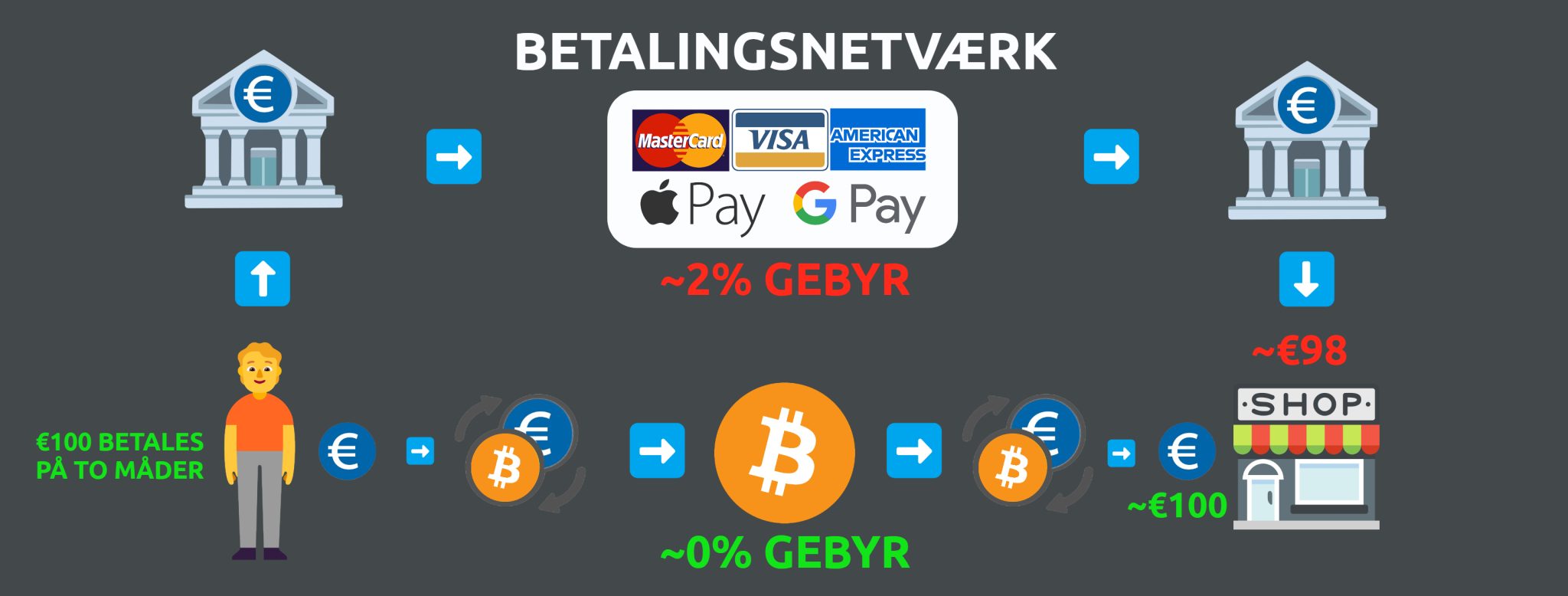 The difference between paying via a traditional payment network and via the Lightning Network.
So neither party has touched BTC, only used the network. Over time, more and more payment solutions using the Lightning Network will emerge, which will quite naturally push fees toward 0%.
Is Bitcoin Too Volatile?
“But Bitcoin is incredibly volatile!”
Correct, if you price the unit in the Danish krone. But the protocol itself is actually the most stable thing we’ve ever witnessed, since the monetary policy has never been and never will be changed.
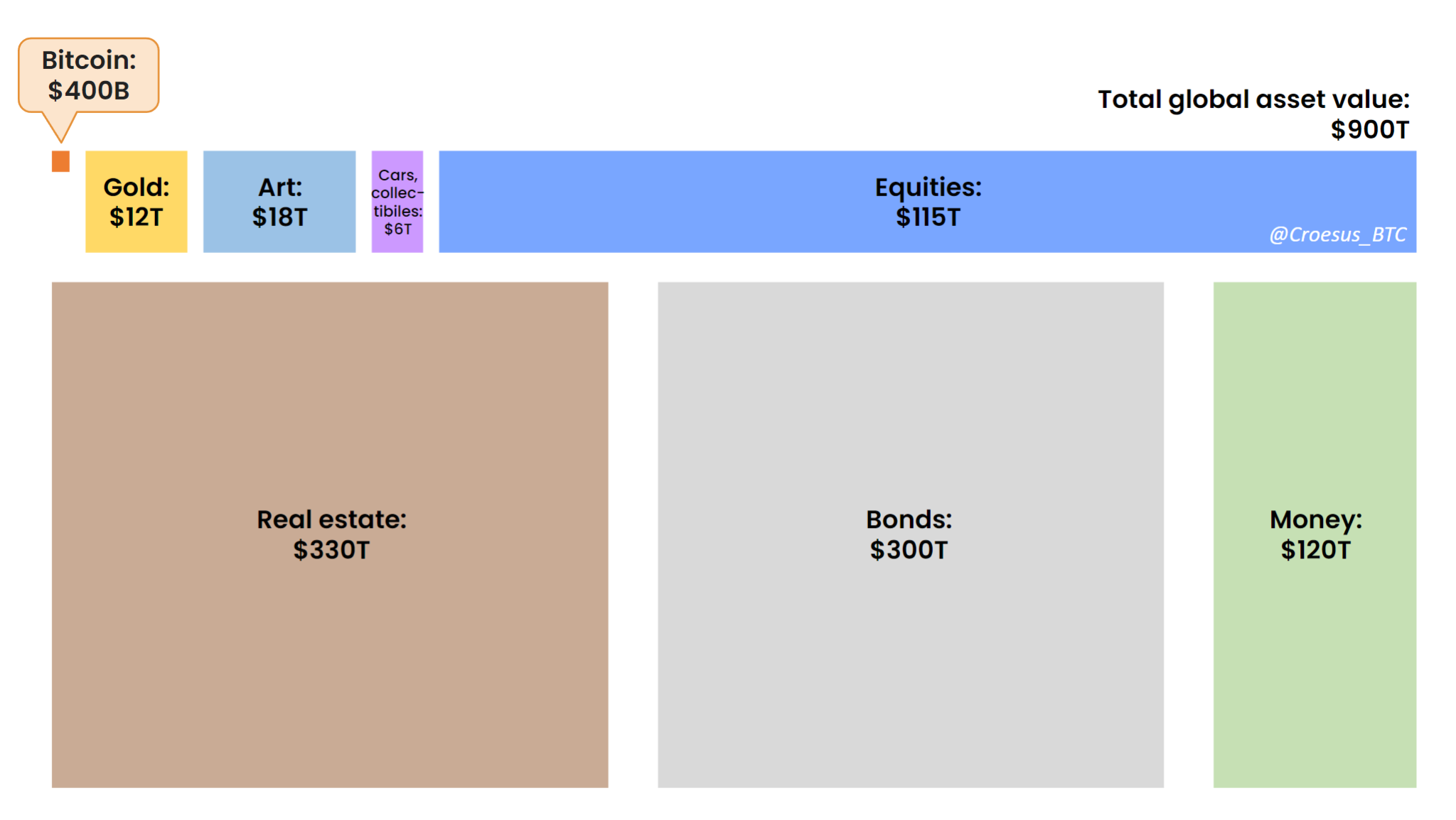
Bitcoin has the potential to absorb over 20% of ALL value in the world; we’re talking property values, currency values (dollar, euro, and so on), stock values, art, and so on, since Bitcoin doesn’t carry the risks that the above investments do:
- no tenants
- no censorship
- no property tax
- no physical size
- no maintenance
- no supply increase
- no risk of destruction
- no possibility of confiscation
- no CEO who can get into controversy
- no chance of a competitor with a better product
So over time, more people will aim for Bitcoin rather than traditional investments.
Property as an Investment
Property is only used as a store of value because people seek not to hold the money itself, which drives property prices up further. Investors avoid all the “flaws” of owning property by holding Bitcoin instead, and so over time more people will move toward digital property, Bitcoin, rather than physical. This will make property less attractive as an investment, and over time it will mainly be regarded as a home again.
Stocks and the S&P 500
Stocks are just a tool used because money loses its value over time. It makes more sense to invest in others’ success than to hold on to the money itself, and on top of that you can get by with smaller amounts than when buying property. In fact, the probably most popular investment fund, the S&P 500, largely just follows money production.
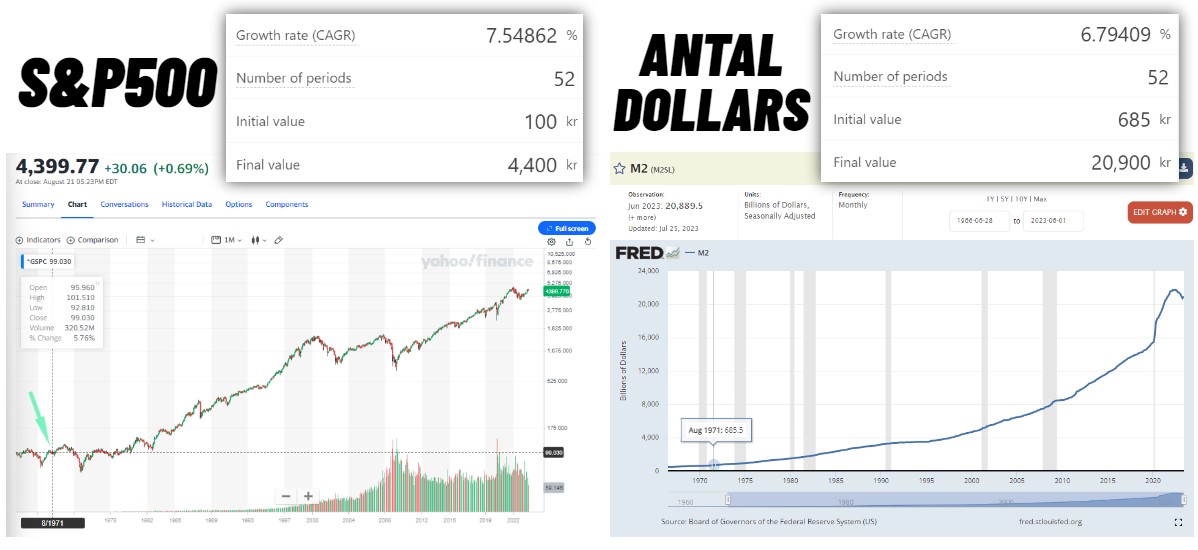
In other words: in a world with a fixed amount of money, your purchasing power in your ordinary savings account would rise nearly as much as the S&P 500 has risen in price each year.
Bitcoin’s Potential
In total, there’s around 900,000,000,000,000 dollars of value in the world, which is why Bitcoin (which only accounts for 0.05% of all that value) has been “volatile”. That’s natural for a 14-year-old project with the potential to solve humanity’s biggest problem: money.
A Conservative Estimate
Let’s do a calculation on the above, for fun:
- $900,000,000,000,000 = 6,400,000,000,000,000 kr
Earlier I mentioned a potential of over 20% of all this value; in my eyes this is a conservative estimate, but let’s stick with it.
- 20% of 6,400,000,000,000,000 kr = 1,280,000,000,000,000 kr
If we divide this by 21,000,000 BTC, we get a price of about 61,000,000 kr per BTC (with the purchasing power the krone has today) — that is, 300 times more than the krone price of a BTC today.
But remember one thing. We humans are constantly becoming more and more productive, since technology is growing exponentially, which means our everyday life will at the same time constantly become cheaper on a Bitcoin Standard.
Have You Missed the Boat?
Have you “missed the boat” with Bitcoin? Not at all. In fact, you’ll never ever “miss the boat” with Bitcoin — that’s the whole point of it. Your everyday life will forever become cheaper when priced in money with a fixed supply.
A more limited asset than Bitcoin can never exist.
Everything will forever trend toward 0 when priced in BTC.
Will People Hold On to Their Money?
“But no one will spend their money if it can buy more and more over time!”
Wrong. We humans are consumers by nature. If we lack food, drink, clothing, or experiences, we spend money on them. A rise in purchasing power would simply mean that we’ll be more thoughtful about what we spend our money on — thereby reducing overproduction.
Healthy Competition
Businesses would then face a wonderful dilemma if no one buys their product:
- Either raise the quality or watch the competitor take over
- Drop the product, since there’s no demand for it
On top of that, we constantly see companies that can’t keep 100% focus on creating and improving their product, because they constantly have to look for stores of value for their profit, and thereby play investor at the same time. If money instead grew in purchasing power, they’d be able to focus 100% on improving the product.
All of this would create incredibly healthy competition between companies to create a product that makes people want to invest their precious money in it. If people don’t, then there isn’t enough demand for your product.
Conclusion
Sooo — to wrap up:
“Abundance in money leads to scarcity everywhere else. Scarcity in money leads to abundance everywhere else.”
— Jeff Booth
This blog post was written by @barekev
You can follow @barekev on Nostr: https://primal.net/barekev or otherwise see https://linktr.ee/barekev