
Privacy
Best practices for privacy and security when using Bitcoin.
Bitcoin was founded on a solid principle of transparency that lets users verify the integrity of the system themselves. Nevertheless, the transparent nature of the Bitcoin protocol does not mean that users can't preserve their financial privacy. This page touches on some of the nuanced aspects of Bitcoin privacy and tries to present some ideas, as well as introduce tools for keeping your transactions confidential.
Transparency is incredibly important in the Bitcoin network. It allows anyone to verify crucial elements, such as adherence to the 21 million bitcoin supply cap and the final settlement of payments, without having to trust a central authority.
Although transactions on the Bitcoin blockchain are publicly available, there are mechanisms in Bitcoin that enable more or less private transactions. For anyone who wants to protect their financial privacy, it's essential to understand how to use these features and tools.
If you haven't yet tried exploring the Bitcoin blockchain, you can see an overview of some tools for it here. If you want to open what's probably the most popular block explorer in a new window, click here: https://www.mempool.space
Being able to see all transactions and addresses helps ensure transparency about what has historically happened on the blockchain. And since no identity is attached to them, it always comes down to how an identity is linked to an address off-chain. For example, a person who receives or sends a bitcoin transaction between you and the other party now knows that you are the owner of a given bitcoin address.
This is one reason it's recommended not to reuse addresses, and fortunately most newer Bitcoin wallets make sure to show a new address every time you request a new payment, for example.
Bitcoin's UTXO model
Bitcoin's UTXO model (Unspent Transaction Output) is an essential part of Bitcoin's transaction mechanism. Instead of following the traditional account model, where an account's balance is updated, Bitcoin uses this model to track unspent transaction outputs. In each transaction, inputs from previous transactions are referenced as UTXOs, and the outputs of the current transaction are created as new UTXOs.
The basic idea is to keep track of which units of bitcoin, or outputs, have not yet been spent. When a transaction takes place, it uses inputs from existing UTXOs and creates new ones, producing an efficient and traceable history of movements on the blockchain. This model contributes to the security and transparency of the Bitcoin network by ensuring that each transaction references previous, valid transactions and uniquely identifies unspent funds.
UTXO and privacy
Bitcoin's UTXO model has significant implications for privacy, as it affects how transactions are handled and traced on the blockchain:
- Pseudonymity, not anonymity: Although Bitcoin transactions aren't directly tied to identities, they are tied to addresses. The UTXO model makes it possible to trace movements of bitcoin across different addresses, which means user activity isn't fully anonymous, but pseudonymous. With enough analysis, someone can follow transactions and try to link them to particular users.
- History and transparency: The UTXO model contributes to a complete and transparent history of movements. While this is an advantage for security and accounting, it can pose a challenge for those who want financial privacy, since all transactions are visible and can be analyzed.
- Address reuse and traceability: As mentioned earlier, if a user reuses a Bitcoin address, it can cause transactions to be linked together, potentially revealing more about the user's financial activities. This can reduce privacy, as more information can be uncovered over time.
- Input and output relationships: When you send a Bitcoin transaction, the UTXO model can also affect your privacy. Bitcoin transactions often use several UTXOs as inputs and create new UTXOs as outputs. This creates a link between previous transactions and the current one, which can potentially reveal more about your financial activities.
- Disclosure of transaction data: It's also important to be aware of whether and how transaction data is shared with third parties. Some services or payment gateways may require additional information that could potentially compromise your privacy.
- Using mixers and privacy tools: To increase the degree of privacy, users can use mixers or CoinJoin protocols, which mix transactions from different participants to make it harder to trace their origin. Implementing privacy tools becomes crucial for those who want to secure their financial privacy.
UTXO example
Let's imagine that a UTXO in our Bitcoin wallet is like an ordinary Danish 1,000-kroner note. You want to buy a book about Bitcoin that costs 200 kr., and the fee for this transaction is 10 kr. If you pay 1,000 kr. for the book, the recipient gets 200 kr., the fee is 10 kr., and you get 790 kr. back in change. In this example, you've now told the recipient of the book payment that you had 1,000 kr., and the recipient now knows you have 790 kr. left — and can keep track, going forward, of how the new 790-kr. UTXO now in your Bitcoin wallet is used in future transactions. See the illustration below, where you can imagine the 1,000 kr. acting as the input in the transaction.
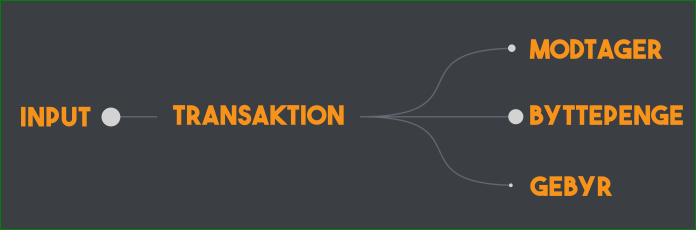
The number and size of the individual UTXOs can be combined and included in the transaction in different ways. This can be important to be aware of when it comes to privacy. With Sparrow, for example, you can add a note to your UTXOs, also known as "labelling".
Summary
On the whole, maintaining privacy on the Bitcoin network requires a combination of careful behavior from users and the use of specialized tools and technologies. It's important to understand that while Bitcoin allows for certain levels of privacy, achieving it requires active awareness and effort from users.
Things worth learning more about if you want to understand privacy on the Bitcoin blockchain include:
- Avoiding address reuse
- UTXO management and labelling
- CoinJoin
- Payjoin
- Liquid, Lightning and eCash
- Running your own Bitcoin node
- The Tor network
- VPN
With the right knowledge and the right tools, you can move around the transparent Bitcoin network safely. As the technology evolves, so do the features and tools that improve privacy for Bitcoin transactions.